
Thursday, October 11, 2012

Thursday, September 1, 2011
Wish Scroll for the New

This Wish Scroll (which is based on scrolls from Ethiopia and one of the sixteen projects in Handmade Books For A Healthy Planet) contains wishes for the new. The idea is that if the scroll is worn, the wish will come true. You can make a scroll for yourself or one for someone else.
For directions and a chance to win a copy of my book, Handmade Books For a Healthy Planet,
go to susangaylord.com and leave a comment. While you're there, you might want to subscribe to the blog. Look to the right for information.
Wednesday, August 17, 2011
Book Arts Tuesday/Herb Book

See the complete project at susangaylord.com.
I am in the process of phasing out this blog so please visit susangaylord.com and subscribe if you want to keep posted. And here's an incentive to make the trip soon: there's a giveaway which closes Thursday (8.18.11) at midnight.
Wednesday, August 10, 2011
Wish Scroll at the Book Nook

Book Arts Tuesday/Bhutanese-Nepali Folktale Project
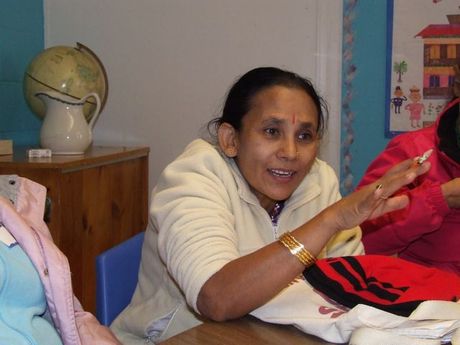
The project began by recording stories from the community. You can hear all of the stories here. The one that was chosen for the book project was The Pumpkin Husband told by Hari Tiwari (pictured above). The first meeting I attended in Laconia, NH was the one in which the story was chosen. Dal Rai, who is doing the illustrations, was there and left with the assignment to prepare a watercolor of a scene in the story. I took some iphone photos of some traditional fabric with the idea that it might be useful in the page design. In addition to decision making and lively conversation, we were treated to delicious soup and noodles prepared by Ambika Sharma.
My second visit was to an ESOL class where Hari told her story once again in Nepali and it was recorded by consulting folklorist Jo Radner. Dal brought us a watercolor painting and several drawings. I was fascinated to see the power of his drawings on the class. Many of the refugees have only memories of their homeland and his pictures gave them visual reminders of the life they left behind. A picture of an ox in a field with a basket muzzling its mouth sparked a lively discussion of farming and basket weaving.
At home, I scanned in Dal's painting and experimented with a design for the illustrated pages. The background is a scan of the Resho paper from Bhutan that I use in my Spirit Book workshops. The border around Dal's painting is from traditional fabric woven in Bhutan.

As the book will be bilingual, I did some experimenting with the page design for the text pages. I found some Nepali writing online as an image and used it for a test. The English is the standard dummy text used in printing. (You can find out some interesting facts about the origin of here.)

My third visit, last week, to Laconia was another visit to Ambika's where we scanned fabric including her beautiful wedding sari.
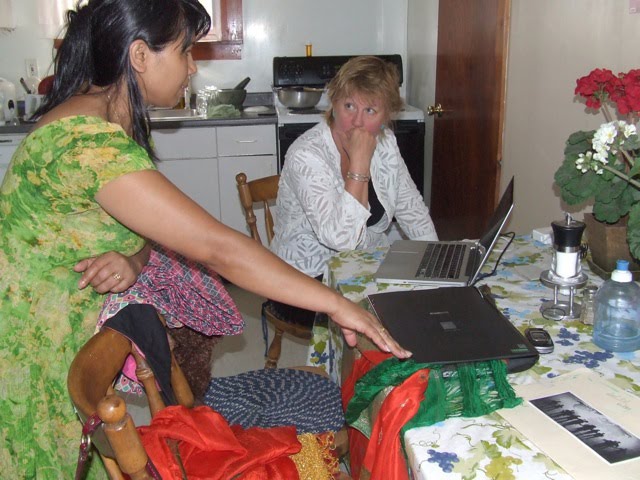

It is a privilege to be part of the project. I'll keep you posted on the progress.
Sunday, August 7, 2011
Studio Sunday/Shelf 2

Tuesday, August 2, 2011
Book Arts Tuesday/International Dunhuang Project

The Bookbinding section of the International Dunhuang Project is a wonderful resource. Here is a little bit of background about the project from the website:
Little was known of the remarkable heritage of the Silk Road until explorers and archaeologists of the early twentieth century uncovered the ruins of ancient cities in the desert sands, revealing astonishing sculptures, murals and manuscripts. One of the most notable discoveries was the Buddhist cave library near the oasis town of Dunhuang on the edge of the Gobi desert in western China. The cave had been sealed and hidden at the end of the first millennium AD and only re-discovered in 1900. Forty thousand manuscripts, paintings and printed documents on paper and silk were found in the cave itself. Tens of thousands more items were excavated from other Silk Road archaeological sites. These unique items have fascinating stories to tell of life on this great trade route from 100 BC to AD 1400. Yet most were dispersed to institutions worldwide in the early 1900s, making access difficult.
Rightfully they pride themselves on sharing the book structures of which there are many forms as well as the texts. There are photographs, diagrams, and thorough descriptions and explanations. This is from the section on Stitched binding (xian zhuang).
There are a number of booklets in the Dunhuang collection that have been bound with thread. The most striking aspect of these books is the fact that they appeared at such an early period. The colophons on some of the booklets tell us that they were copied and bound during the Tang dynasty (AD 618-907), some six hundred years before the emergence of mature thread binding books in the Ming. What is also surprising is that there was a whole variety of stitching techniques already being applied. It would be interesting, therefore, to have a look at some of these different techniques in order to understand the nature of this development in bookbinding.


The information is also available as a downloadable pdf. Thanks to Colin Chinnery for the text and Li Yi and Colin Chinnery for the diagrams.
International Dunhuang Project/Bookbinding
Subscribe to:
Posts (Atom)


