Tuesday, October 9, 2007

Book of Leaves

leaves1
leaves2

http://www.makingbooks.com/elastic.shtml

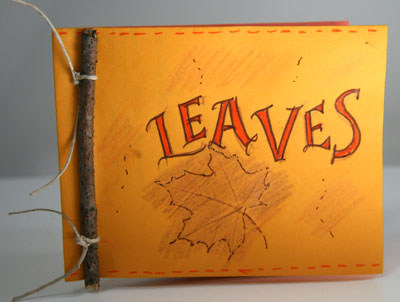
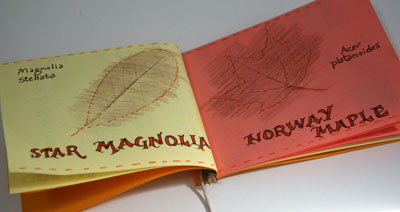
Fall is a time when we pay special attention to leaves in New England. This month's project is a Book of Leaves with leaf rubbings on each page. I tried the rubbings with both crayon and colored pencil and preferred the colored pencil, but you might decide otherwise. You could also attach the actual leaves or make leaf prints with paint.

You will need two or more pieces of paper, a stick, and an elastic or 2 pieces of cord or yarn. In keeping with my current focus on using recycled materials whenever possible, I used three pieces of paper that had writing on one side only (flyers that I was given at a conference).

1. Fold each paper in half the long way so that is long and skinny like a hot dog. If it has writing on it, the writing should be on the inside.

2. Fold each paper in half the other way.

3. Tuck the folded pages inside each other.

4. Punch two holes a little way in from the folded edge, one toward the top and one toward the bottom. I find that I am only able to punch through all the layers at once if I use 2 sheets of paper. If you use more, you may have to punch the holes in one or two sheets and then use that as a guide to mark the placement of holes for the rest of the paper.

5. Make the leaf rubbings on the pages. I think it is easier to make the leaf rubbings before you bind the book with the stick because the pages lay flatter. I punch the holes first to serve as a visual guide. If your rubbing is too close to the fold, part of it will be hidden under the binding.

6. Follow the directions to bind the book together. Because I wanted a more earthy look to my book than an elastic would provide, I used two pieces of hemp cord. I tied the two pieces together toward the end. I inserted the two ends in the top hole, pulled both pieces of cord along the back of the book and up into the bottom hole. I pulled the cord tightly and tied the two ends together in the front at the bottom hole.

Links

Why Leaves Change Color
A simple explanation written for children can be found at
http://www.sciencemadesimple.com/leaves.html

and a more detailed explanation at
http://www.na.fs.fed.us/spfo/pubs/misc/autumn/autumn_colors.htm

Big Dipper and the Colors of Autumn
Retelling of Algonquin legend which explains why leaves change their color in the fall
http://starryskies.com/articles/dln/9-97/dipper.colours.html

Tree Identification
Have a leaf with you and click on the leaf key at the bottom of the page. It will lead through a process to identify your leaf.
http://www.fw.vt.edu/dendro/forsite/Idtree.htm

No Child Left Inside
Leave No Child Inside, an article by Richard Louv in the March/April 2007 issue of Orion magazine
http://www.orionmagazine.org/index.php/articles/article/240

Richard Louv's website
http://thefuturesedge.com

Last Child in the Woods has had great impact. Giving No Child Left Behind a twist, there is a movement that grew out of the book called No Child Left Inside. I couldn't find a central website but searching No Child Left Inside will bring up many sites and blogs.


Adapted from the October 2007 issue of Making Books Monthly
Free subscriptions available at makingbooks.com.

Art, Books, And Creativity


"Art, Books, and Creativity is a yearlong arts curriculum developed by the National Museum of Women in the Arts. ABC provides meaningful arts learning experiences while highlighting the natural connections between visual arts and language arts. ABC is a model for integrating the visual arts into the core curriculum while maintaining a specific focus on the contributions of women artists to our shared cultural history.

The ABC curriculum promotes visual literacy by developing students' skills in observation, reflection, and arts creation. The curriculum unites visual art and writing through the creation of artists' books, an art form especially suited to linking imagery and language."

There are directions for several book forms and creating a pop-up as well as lots of information and inspiration about integrating bookmaking into the curriculum.

Thursday, September 27, 2007

Family Workshop Report


One of the facts of life is that there are always lessons to be learned. There were a few at the Earth-Friendly Bookmaking for Families workshop at the Newburyport Public library last Saturday. The first was that having people sign up ahead is a good thing. For this one, since the format I planned was informal and didn't require knowing numbers, I decided not to bother. The last time I gave a family workshop at the library, with sign-up, we had a full house. This time attendance was very low. It could have been the time, the season, the topic, or the fact that people had to bring materials, but I think people are much more likely to come to something they have already made some level of commitment. Plus when there is a sign-up, the Children's Room staff always calls the day before with reminders.

Most of my workshops are done in schools which is a much more controlled setting, even in the case of evening family workshops. Teachers can remind the students, send notes home, etc. I think in the future in public settings I will ask the staff to gather materials for me and not require the participants to bring anything which is the way I have done things for years.

The happy lesson is a confirmation of the innate openness and creativity of kids. I am in the planning stages of a book for families on making books with recycled materials. As I think about it, I feel that in some ways it is the parents who need the book more than the kids. Although we lament, and with good reason, the amount of time kids spent in front of the computer and TV, I take heart in the fact that when kids are presented with what they need to sit and create, they do it with enthusiasm. When they make a book, they can't wait to write, draw, or collage in it. Adults on the other hand are often timid and reserved. They are afraid to dive right in.


The library experience also demonstrated the power of the collage box. I collect paper from all kinds of sources. Everyone in the house knows to keep the wrapping paper for me after the presents have been opened. I save scraps of art papers, old calendars, interesting envelopes, can labels, catalogs, and anything else that catches my eye. I cut or tear them up into smallish pieces. I am a firm believer that everyone is creative. One of the problems with creating on paper is that so many people assume it is necessary to draw well to do so. The colorful papers in the collage box are a friendly entry and a great way to get children and adults working.

Wednesday, September 12, 2007

Crayon and Paint Palm Leaf Book

http://www.makingbooks.com/palmleaf.shtml

The traditional form of book in India and Southeast Asia is made from the leaves of palm trees. Traditionally the writing and illustration are done with a metal stylus. The writing is scratched into the leaf, after which ink is rubbed over the page and the excess ink is wiped away. Our book is made with a reverse process. The paper is colored with crayons and then painted with black ink. The writing and illustrations are scratched into the paint to reveal the crayon colors.

I used the inside of the front panel of a cereal box. I have found using recycled materials to be very liberating. When you start with a piece that has edges that you have cut yourself, it frees you from worrying about evenness and precision.

Making the Book
You will need one piece of cover stock or one panel of a cereal box, a piece of yarn, and two beads, buttons or the closure tags from bread bags.

1. Color the entire surface with different colored crayons. Paint over the crayon with black poster paint. I used two coats for solid coverage.

2. Hold the paper in front of you vertically. Find the center by eye and push the punch in as far as it will go. Again by eye, cut off a strip so that the punched hole is in the center. You may find it easier to judge if you are looking at the side which does not have the crayon and paint.

3. Use the strip you just made as a guide, and cut up the rest of the paper. Punch a hole in the center of each strip.

4. Follow the directions on the website to complete the book.

5. Do the writing and illustrations with a stick or a bamboo skewer with the pointy ends trimmed off to prevent eye injury.

Links


Information about Palm Leaf Books

A photo of an illustrated palm leaf book made in Bali from my collection and a text written for children can be found at
http://www.makingbooks.com/booksaroundtheworld.shtml

Photo of and brief information on a palm leaf book from the library at Cornell.
Click on the photo for a larger image. To explore books from other cultures, go to the Table of Contents. This website offers a concise, well-illustrated journey through books made from paper, leather, clay, and stone.
http://rmc.library.cornell.edu/Paper-exhibit/palmleaf.html

Information on the construction of palm leaf books from the Buddha Mind website.
This one is the most direct. Make sure you click on the small images on the left; they will lead you to more images.
http://www.buddhamind.info/leftside/arty/script/leafs.htm

The Preparation of Palm Leaf Documents from the Princely States Report of the Journal of Indian States History, Philately, and Numismatics
This is a bit dry but has good information and illustrations of the styluses used for writing and photos of book pages.
http://princelystates.com/ArchivedFeatures/fa-03-05.shtml

An article I wrote about Traditional Cambodian Books appeared in the September 1998 issue of FACES magazine. Each issue of the magazine focuses on a particular culture or topic. With the help of an interpreter, I interviewed the Venerable Sao Khon, the senior monk at the Triratanaram Temple in North Chelmsford, MA for the article.

Books by Artists using the Palm Leaf Book structure

Nigrum by Shu-Ju Wang, Click on the third image down on the left for a full photo and information.
http://fingerstothebone.com/portfolio/nigrum.html

Under the Ice by Mia Leijonstedt
http://www.galleriamia.net/ArtBinding8a.htm


Adapted from the September 2007 issue of Making Books Monthly
Free subscriptions available at makingbooks.com

Earth-Friendly Bookmaking with Families


I will be giving a drop-in workshop for families at the Newburyport Public Library on Saturday, September 22, from 10 am to 12 noon. Making books is a great family activity that gives us opportunities to record our observations of the world around us and celebrate our lives. When we use recycled materials, we consume less paper and also learn to look creatively at the things we discard. There is magic in the process as we transform boxes and bags into books.

The program room will be set up with four bookmaking stations with a different project at each. Lots of samples will be on hand to inspire continued bookmaking at home. After thirty years as an artist and educator, I am a believer in the value of exercising one's creativity for people of all ages. Bookmaking is an easy entry into creative work and I have made the process as accessible as possible. All the books are simple to construct and using recycled materials makes it affordable and easy to get started.

Admission to the workshop is free but each person who plans to make books should bring 1 grocery bag, 1 cereal box, and 4-5 sheets of used copy paper with writing on one side only.

This workshop is for families in Newburyport and the surrounding towns. I am working on a book proposal on this topic and would be interested in giving similar workshops at other libraries in the area. Let me know if you know a library that might be interested.

Here is pdf of the flyer for the Newburyport workshop.

Thursday, August 9, 2007

Joseph Cornell Accordion Book

Buddha Accordion
http://www.makingbooks.com/indexcard.shtml

Last week I went to see a wonderful exhibition at the Peabody Essex Museum called Joseph Cornell: Navigating the Imagination. While best known for his boxes, Joseph Cornell also made collages, films, and a few books. There was one book that would fit into the category of altered book, several portfolio style boxes, and one accordion book.

His work combines found objects and images in surprising ways. I liked one of the descriptive tags so much I copied it. "In the late 1930's a chance encounter with caged tropical birds displayed against a pet shop's stark white walls made such a 'dazzling' impression that Cornell believed it changed his way of seeing 'the simplicity of magic' in the everyday." Our project for the month is an accordion book where we can express the "simplicity of magic" of the everyday in our lives.

Making the Book
You will need two long pieces of sturdy paper or cover stock or the back panel of a brown grocery bag cut in half vertically. I used the front panel of a large cereal box cut in half vertically. It was a little awkward to fold but made an accordion that stood up well for display.

This accordion will have eight pages. Follow the directions for making the accordion. Trim off the tab at the end. You are ready to add your collage images. Joseph Cornell used images of the things that he loved, including birds, ballerinas, and movie stars. Collect images of things you care about- flowers, musicians, baseball players, birds, and make your own book. Magazines and catalogs are good sources of imagery.

Links

Joseph Cornell: Navigating the Imagination
The Peabody Essex Museum has an excellent interactive online companion to the exhibition.
http://pem.org/cornell/

Guardian article by Jonathan Safran Foer, editor of A Convergence of Birds, original fiction and poetry inspired by the work of Joseph Cornell
http://arts.guardian.co.uk/features/story/0,,1778945,00.html

Straightforward presentations of images of Joseph Cornells' collages and boxes
http://josephcornell.org/list.html

Smithsonian Archives of American Art
Collections Online: Joseph Cornell
View some of his papers including diaries, letters, art works, and ephemera.
http://www.aaa.si.edu/collectionsonline/cornjose/index.cfm/fuseaction/Main.Overview

Albright-Knox Art Gallery
Information about Joseph Cornell and one of Soap Bubble Set boxes with suggestions for an activity for children
http://www.albrightknox.org/ArtStart/Cornell.html

in good spirit Blog
More reflections on the Joseph Cornell exhibit and Edward Hopper at the MFA in Boston are on my art blog, ingoodspirit. Both exhibits close on August 19.

Adapted from the August 2007 issue of Making Books Monthly
Free subscriptions available at makingbooks.com

Fall Workshops

Record, Reflect, Reminisce (Reuse, Reduce, Recycle)
Fiber Art Center
79 S. Pleasant St.
Amherst, MA
Saturday, October 13
10:00-4:30

This workshop is for anyone who works with or spends time with
children or who would like an introduction to simple bookmaking
techniques. In addition to the tactile pleasures of working with our
hands, handmade books give us places to celebrate our lives and the
world around us. Learning to look at the abundance of materials
around us for their potential in bookmaking encourages creativity as
well as benefits the environment. Come and have fun while building a
repertoire of creative projects for children of all ages.


Making Books with Recycled Materials Part I
Center for Global Education
Framingham State College
Framingham, MA
Saturday, October 20
9:00-3:00

Making books is a wonderful teaching tool across the curriculum. In this hands-on workshop, we will use recycled materials (paper grocery bags, cereal boxes, used copy paper) almost exclusively.With the increasing attention to environmental issues and climate change, it is time to think about what resources we consume as we teach. Print and web resources for children on recycling and environmental issues will be shared but the workshop time will spent in the creation of books. A materials list will be sent on registration. You are welcome to bring a camera to photograph Susan's samples.


Books Around the World and Across the Curriculum
Global Education Center
Winchester, MA
Saturday, November 3
9:00-12:00

Embark on a journey of cultural discovery. In this hands-on workshop, you'll learn how to make a variety of book forms from around the world including scrolls from Africa, slat books from China, palm leaf books from Southeast Asia, and accordion books from Mexico, a bit about their history, and how to use them across curriculum. The emphasis is on simple techniques and recycled materials. You'll leave with lots of samples and even more ideas.