Monday, April 21, 2008

St. George's Day


is April 23rd. He is the patron saint of several countries including Catalonia in Spain, England, Portugal, Georgia, Serbia, Bulgaria, Bosnia and Herzegovina, and the Republic of Macedonia. St. George's Day in Catalonia is especially rich as it celebrates three things: St. George who fought and slayed the dragon and the day of the deaths of Miguel Cervantes and William Shakespeare (April 23, 1616). Boys and men give their girlfriends and wives roses; girls and women give their boyfriends and husbands books.


The Creative Year
has a simple book project as well as directions for making a paper rose.

Saturday, April 12, 2008

Green Bookmaking Workshop in Newburyport


Green Bookmaking for Families
at the Newburyport Literary Festival

Saturday, April 26, 12:30-2:30
Unitarian Universalist Church (downstairs, entrance on the left if you are facing the church)
26 Pleasant Street
Newburyport, MA

Family bookmaking engages the hands, the head, and the heart. All ages are welcome to drop in to craft an environmentally green book from recycled materials. See where your imagination will take you, and have something to bring home when it's finished.

The Newburyport Literary Festival is a wonderful free event with something for all ages. Check out the website to see the complete schedule.

Opening Day


http://www.makingbooks.com/whoami.shtml

Last year I was making books at the Bryn Mawr Elementary School in Auburn, MA on Opening Day of the Red Sox at Fenway Park. Everyone was dressed in Red Sox garb and the school cafeteria served hot dogs for lunch. One class made a Who Am I? Book and most of the class planned to make their books about Red Sox players. It is a reminder that children need to spend time writing about their loves and interests as well as curriculum material. This month's links are websites relating baseball and curriculum, but children can make books about their favorite stars of other sports, bands and singers, actors, actresses, dancers, and musicians. I made my book from the back panel of a grocery bag (the one without any writing). I used a cereal box for the cover and velcro instead of yarn. It's about one of my favorite Red Sox players, Jacoby Ellsbury.

LINKS

Major League Baseball
http://mlb.mlb.com/index.jsp
A good place to research players and teams.

Take Them Out To the Ball Game!
http://www.education-world.com/a_lesson/lesson107.shtml
Education World has a page with lots of links to sites for using baseball across the curriculum, including the text of Abbott and Costello's Who's On First? and several sites for baseball math.

Science of Baseball from the Exploratorium in San Francisco
http://www.exploratorium.edu/baseball/index.html
Lots of good stuff including how to find the sweet spot on a bat, an experiment with bouncing and temperature, how to throw different pitches using a styrofoam ball, and much more.

Math Baseball
http://www.funbrain.com/math/index.html
Answer addition, subtraction, multiplication, and division problems and hit the "Swing" button. Correct answers are hits. Whether it is a single, double, triple, or home run is based on the difficulty of the problem. Wrong answers are outs and the game lasts for three outs. There is a choice of levels from easy to superbrain and it can be played with one or two players.

Adapted from the April 2008 issue of Making Books Monthly
Free subscriptions available at makingbooks.com.

Friday, April 11, 2008

Children's Voices: A Celebration of Poetry


The Newburyport Literary Festival takes place on April 25-27. This year the Festival honors local poet Rhina Espaillat. In connection with the theme of poetry, the Firehouse Gallery has an exhibition of poems by children. Kindergartners from the Brown selected and illustrated poems while students from the Bresnahan wrote and illustrated ones of their own. The poems are on a variety of subjects: nature, the seasons, friendship, sports, food, and family and in a variety of forms: acrostic poems, limericks, diamante poems, rhyming verses, and free verse. Written on colored paper and graced with lively illustrations, the display is a visual as well as verbal treat.

Some of the poems:

I am the turquoise blue ocean of Bermuda.
It feels good when people dive in me.
I feel happy when the sun generously shines on me.
I get angry when people pollute me.

There once was a small lad from Cork.
He especially loved the pork.
He ate and he ate.
His size became great.
He realized he was a dork.

You can smell the chocolate,
You can taste the goodness,
Touch it and never stop,
And it all came from my mom.

Children's Voices will be on display through April 27 during normal Firehouse Gallery hours (Wednesday through Sunday 12-5 pm with extended viewing on performance mights until curtain time ) and throughout the Literary Festival.

Monday, March 17, 2008

PoeTree


http://www.makingbooks.com/hotdog.shtml

   Last fall I made a "PoeTree" by hanging small books with a poem written in each on branches I placed in an empty can. I'm taking the idea of poems on trees out into the community with The PoeTree Project as part of the Newburyport Literary Festival at the end of April. Students at the Nock Middle School are writing short poems on strips of tyvek which will hang from trees in the downtown area and in front of the Festival venues. I was inspired byan image of Japanese folding screen from the Art Institute of Chicago.

This month's project is a PoeTree. Fun at any time, it is especially appropriate for National Poetry Month which is next month.

I made small books from used 8.5 x 11 copy paper that had writing on one side. If you use repurposed paper, the writing should be on the inside when you make the first (hot dog) fold. I chose short poems by some of my favorite poets but you may want to write your own.

To make the hanger, you'll need a piece of yarn about 24" and a bead.
1. Fold one piece of yarn in half and thread folded end through the bead. Leaving a loop for hanging, tie a knot with the bead inside the knot. If you don't have a bead, you can just tie a knot.

2. Place the bead on top of the book and separate the two ends of yarn. Place one along the outside spine of the book and the other inside along the center of the book.

3. Tie a double knot at the bottom of the book.


LINKS

Writing Poetry with Jack Prelutsky
http://teacher.scholastic.com/writewit/poetry/jack_home.htm
A thorough and fun poetry lesson with Jack Prelutsky.

Giggle Poetry with Bruce Lansky
http://www.gigglepoetry.com/
Website of Bruce Lansky chock full of poetry and information: Poetry Class, Poetry Fun, Poetry Theater, and lots more.

The Poetry Zone
http://www.poetryzone.ndirect.co.uk/index2.htm
The Poetry Zone publishes poems by children online, has a section called Poets Talk with interviews of writers of children's poetry, and includes resources for teachers

Adapted from the March 2008 issue of Making Books Monthly
Free subscriptions available at makingbooks.com.

Thursday, February 14, 2008

Adinkra Symbols Accordion Book


http://www.makingbooks.com/accordion.shtml

When I was thinking about hearts and Valentine's Day, I remembered that a couple of the adinkra symbols from Ghana are heart-shaped and how attached to the symbols I became when I included an adinkra paper cloth project in Multicultural Books To Make And Share. Here's some additional information from the book:

Adinkra cloths are made in Ghana. First made as mourning cloths, they came to be used for other occasions as well. Kings and rich people commissioned cloths to speak of their power. People embarking on a new venture, such as starting a business, might commission a cloth. Most cloths are printed, although some are appliqued. The stamps for printing are cut from a gourd. The black dye is a mixture made from the boiled bark of the badie tree and an iron-rich stone. The dye is called adinkra, which means farewell. The symbols used in printing have a long tradition and deep significance. Through the symbols, each cloth communicates information about the owner, living or dead. The symbols are so much a part of Ghanaian culture that they are often used by the government and clergy. The logo of the Standards Board in Ghana is the measuring rod, which stands for excellence and intolerance of imperfection.

I used one-half of the back panel of a grocery bag for the pages and the front panel of a cereal box for the covers. I covered the covers with paper cut from the other half of the grocery bag panel. You can use this pdf from Multicultural Books To Make And Share to make patterns to trace for your own adinkra symbols book. They are designed to be traced on a folded piece of paper, then cut and opened to form the complete pattern. I traced the patterns with pencil and then outlined and colored them with black marker. For a longer book, you can follow the directions for attaching sections in the directions for the Index Card Accordion.

Links

Adinkra Symbols & Meanings
http://www.welltempered.net/adinkra/htmls/adinkra_index.htm
Extensive collection of adinkra symbols with information on meaning and in some cases images of the symbols being used in West Africa

Cool Planet: Oxfam's Site for Kids
http://www.oxfam.org.uk/coolplanet/ontheline/schools/adinkra/adinkrah.htm
Information on the history, how the cloths are made, the symbols, and a printmaking activity

Adinkra Resources
http://www.riscwebsite.org.uk/adinkra/
This website was created to accompany a book for educators. Of particular interest are the image pages which include cloths and printing blocks, production, and uses of the symbols.

The Talking Cloth by Rhonda Mitchell

African- American Amber visits her Aunt Phoebe whose house is full of things Amber's father calls junk and her aunt calls her "collection of life." Amber's favorite is an adinkra cloth from Ghana. There are descriptions of the cloth and the meaning of some of the symbols. Amber imagines the cloths she would make for her family.


Adapted from the February 2008 issue of Making Books Monthly
Free subscriptions available at makingbooks.com.

Multicultural Books To Make And Share


Cover


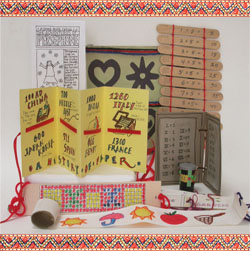
Take a cultural journey around the world with sixteen bookmaking projects that work across the curriculum. This book makes it easy with accessible materials, hints for preparation, clear directions, and historical information.

AFRICA
Name Scroll
Learn about the development of the alphabet from Egyptian hieroglyphics with this simple scroll that uses pictures to write out a name.
Zulu Beadwork
Make a necklace or pendant with graph paper and learn about the symbolic language of beads in South Africa.

Wish Scroll from Ethiopia
Recycle a film container to make a wish scroll based on talismans made in Ethiopia for personal protection and cures.

Adinkra Cloth
Create a construction paper cloth for a historical person or book character based on adinkra cloths from Ghana.

THE AMERICAS
Winter Count
Dakota Indians counted the years by winters and marked each winter with an image drawn on a buffalo skin. Use a brown grocery bag to make your own.

Time Line Accordion
Make an accordion book with a ribbon threaded through to act as a time line and learn about the books made by the Aztecs and Mayans.

Comic Book
Write and illustrate a comic book in this simple eight page book made from one piece of paper.

Curandero Book
This project is inspired by accordion books made by Otomi Indian healers in Mexico. Illustrate your book with cut-outs made from pieces of brown bags.

ASIA
Palm Leaf Sequence Book
In India, Indonesia, and Southeast Asia, traditional books are made from palm leaves. Make your own palm leaf book from stiff paper.

Math Slat Book
Learn multiplication facts by making a slat book which was the first book form made in ancient China.

Seasons Accordion Book
Celebrate the seasons with this four page accordion book with a ribbon tie.

Book of Haiku
Sew a book with a side-stitched Asian binding and fill it with haiku and simple cut paper illustrations.

EUROPE
Rune Stone
The Vikings erected rune stones as memorials to the dead or announcements of the accomplishments of the living. Use the rune alphabet provided to make a stone for a family member, friend, historical figure, or fictional character.

Pugillares
Romans wrote notes in wooden books with wax covered pages. Make your own version with card stock and wax paper.

Newsbook
Write about a specific event in history or current events in a book modeled after the Newsbooks of Europe which were the forerunners of newspapers.

Medieval Book
Make a Medieval Book of Hours or Word Book with decorated foil covers and illuminated initials.

Click on the image for more information