The herbs are abundant and fragrant this time of year. While the flowers are modest, the shape, texture, and colors of the leaves bring interest to the garden. This month's project, an index card accordion herbal, focuses on the leaves. The book is currently decorating a side table in the dining room and also can be used to identify herbs in the garden for novice gatherers.
See the complete project at susangaylord.com.
I am in the process of phasing out this blog so please visit susangaylord.com and subscribe if you want to keep posted. And here's an incentive to make the trip soon: there's a giveaway which closes Thursday (8.18.11) at midnight.
Showing posts with label Book Arts Tuesday. Show all posts
Wednesday, August 17, 2011
Wednesday, August 10, 2011
Book Arts Tuesday/Bhutanese-Nepali Folktale Project
I am thrilled to be working on the Bhutanese Nepali Folktale Project which is part of the The New Hampshire Humanities Council statewide literacy initiative called Connections.The project's goals are: to create a bilingual picture book that supports English language acquisition of new Americans from Bhutan, to preserve a traditional tale in the mother tongue, and to present a story for children from all cultures to read. I was invited to get involved by the Literacy Coordinator, and wonderful writer, Terry Farish.
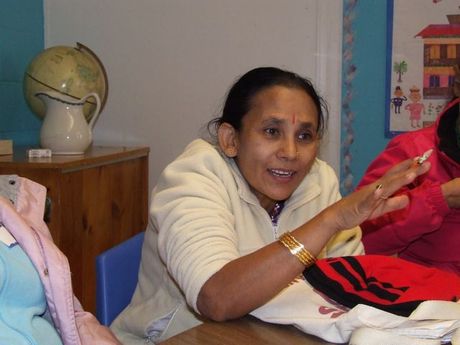
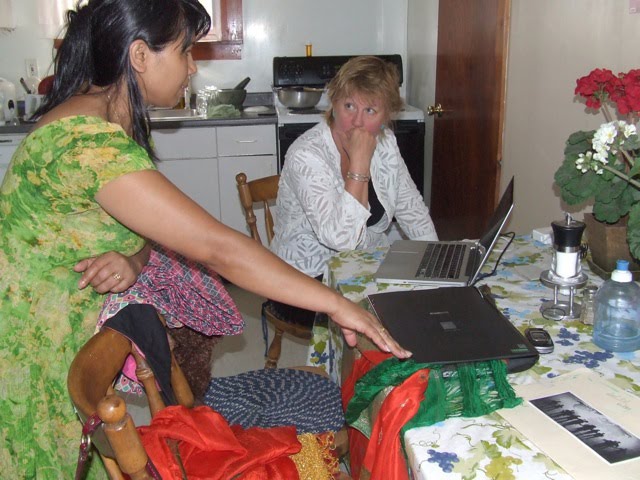
The project began by recording stories from the community. You can hear all of the stories here. The one that was chosen for the book project was The Pumpkin Husband told by Hari Tiwari (pictured above). The first meeting I attended in Laconia, NH was the one in which the story was chosen. Dal Rai, who is doing the illustrations, was there and left with the assignment to prepare a watercolor of a scene in the story. I took some iphone photos of some traditional fabric with the idea that it might be useful in the page design. In addition to decision making and lively conversation, we were treated to delicious soup and noodles prepared by Ambika Sharma.
My second visit was to an ESOL class where Hari told her story once again in Nepali and it was recorded by consulting folklorist Jo Radner. Dal brought us a watercolor painting and several drawings. I was fascinated to see the power of his drawings on the class. Many of the refugees have only memories of their homeland and his pictures gave them visual reminders of the life they left behind. A picture of an ox in a field with a basket muzzling its mouth sparked a lively discussion of farming and basket weaving.
At home, I scanned in Dal's painting and experimented with a design for the illustrated pages. The background is a scan of the Resho paper from Bhutan that I use in my Spirit Book workshops. The border around Dal's painting is from traditional fabric woven in Bhutan.
As the book will be bilingual, I did some experimenting with the page design for the text pages. I found some Nepali writing online as an image and used it for a test. The English is the standard dummy text used in printing. (You can find out some interesting facts about the origin of here.)
My third visit, last week, to Laconia was another visit to Ambika's where we scanned fabric including her beautiful wedding sari.
It is a privilege to be part of the project. I'll keep you posted on the progress.
The project began by recording stories from the community. You can hear all of the stories here. The one that was chosen for the book project was The Pumpkin Husband told by Hari Tiwari (pictured above). The first meeting I attended in Laconia, NH was the one in which the story was chosen. Dal Rai, who is doing the illustrations, was there and left with the assignment to prepare a watercolor of a scene in the story. I took some iphone photos of some traditional fabric with the idea that it might be useful in the page design. In addition to decision making and lively conversation, we were treated to delicious soup and noodles prepared by Ambika Sharma.
My second visit was to an ESOL class where Hari told her story once again in Nepali and it was recorded by consulting folklorist Jo Radner. Dal brought us a watercolor painting and several drawings. I was fascinated to see the power of his drawings on the class. Many of the refugees have only memories of their homeland and his pictures gave them visual reminders of the life they left behind. A picture of an ox in a field with a basket muzzling its mouth sparked a lively discussion of farming and basket weaving.
At home, I scanned in Dal's painting and experimented with a design for the illustrated pages. The background is a scan of the Resho paper from Bhutan that I use in my Spirit Book workshops. The border around Dal's painting is from traditional fabric woven in Bhutan.
As the book will be bilingual, I did some experimenting with the page design for the text pages. I found some Nepali writing online as an image and used it for a test. The English is the standard dummy text used in printing. (You can find out some interesting facts about the origin of here.)
My third visit, last week, to Laconia was another visit to Ambika's where we scanned fabric including her beautiful wedding sari.
It is a privilege to be part of the project. I'll keep you posted on the progress.
Tuesday, August 2, 2011
Book Arts Tuesday/International Dunhuang Project
The Bookbinding section of the International Dunhuang Project is a wonderful resource. Here is a little bit of background about the project from the website:
Little was known of the remarkable heritage of the Silk Road until explorers and archaeologists of the early twentieth century uncovered the ruins of ancient cities in the desert sands, revealing astonishing sculptures, murals and manuscripts. One of the most notable discoveries was the Buddhist cave library near the oasis town of Dunhuang on the edge of the Gobi desert in western China. The cave had been sealed and hidden at the end of the first millennium AD and only re-discovered in 1900. Forty thousand manuscripts, paintings and printed documents on paper and silk were found in the cave itself. Tens of thousands more items were excavated from other Silk Road archaeological sites. These unique items have fascinating stories to tell of life on this great trade route from 100 BC to AD 1400. Yet most were dispersed to institutions worldwide in the early 1900s, making access difficult.
Rightfully they pride themselves on sharing the book structures of which there are many forms as well as the texts. There are photographs, diagrams, and thorough descriptions and explanations. This is from the section on Stitched binding (xian zhuang).
There are a number of booklets in the Dunhuang collection that have been bound with thread. The most striking aspect of these books is the fact that they appeared at such an early period. The colophons on some of the booklets tell us that they were copied and bound during the Tang dynasty (AD 618-907), some six hundred years before the emergence of mature thread binding books in the Ming. What is also surprising is that there was a whole variety of stitching techniques already being applied. It would be interesting, therefore, to have a look at some of these different techniques in order to understand the nature of this development in bookbinding.
The information is also available as a downloadable pdf. Thanks to Colin Chinnery for the text and Li Yi and Colin Chinnery for the diagrams.
International Dunhuang Project/Bookbinding
Tuesday, July 19, 2011
Book Arts Tuesday/Asian Books
Since the beginning of my interest in bookmaking, I have been drawn to the books of Asia. I love the range of materials from paper to palm leaves and the simplicity of the structures. I have a small collection grown from occasional shop purchases and the kindness of traveling friends who have sought out books for me. Although my teaching is very much about books as vehicles for content, I also have a deep love of books as objects. These images are a tribute to that love.
The top image was made from a book that Marie Oedel purchased in Bhutan.
The second from a palm leaf book I purchased in Great Barrington, MA at Barong Imports.
The top image was made from a book that Marie Oedel purchased in Bhutan.
The second from a palm leaf book I purchased in Great Barrington, MA at Barong Imports.
Tuesday, July 12, 2011
Book Arts Tuesday/Women Binders in the Late 19th, Early 20th Centuries
A recent conversation on the Book Arts List led to an exploration of some women binders in the late 18th and early 20th Century. A request from Karen Hanmer for information about book arts in Halifax led to Barbara Kretzmann's post about the Prat sisters of Nova Scotia who ran the Primrose Bindery in NYC. Susan Mills connected us to the virtual archives of Nova Scotia which has a section on the Prat sisters. Here is part of the introduction:
Annie, Minnie and May Prat, adventurous sisters from Wolfville, Nova Scotia, embarked on unusual artistic careers in the United States in the late 1890s. In 1896, Annie, 35, enrolled at the School of the Art Institute of Chicago. In 1897, Minnie, 29, moved to New York City to learn bookbinding with Evelyn Nordhoff, who had herself apprenticed in England with noted Arts and Crafts bookbinder, T.J. Cobden-Sanderson. May Rosina, 26, joined Minnie shortly afterward to study decorative leatherwork and bookbinding with Nordhoff.
The sisters had a fascinating circle of friends, centered around the Prat family home in Wolfville. Chief among them were poets Charles G.D. Roberts and his cousin, Bliss Carman, and Charles G.D.'s younger brother, Goodridge, who was engaged to Minnie. In 1892 tragedy struck the Prat family circle. On February 4, a month before Minnie's 24th birthday, Goodridge, 22, died of influenza at the Prat family home. Her father, Samuel, died of the same illness nine days later.
Five years later, Minnie found the courage to go to New York to apprentice with Nordhoff, in a field in which women were still pioneers. Bliss Carman, then living in New York, had arranged for the apprenticeship. Evelyn Nordhoff died unexpectedly in November 1898, at the age of 33, after a short illness. Minnie, May Rosina, and other former students kept her bindery going after her death.
In addition to an illustrated essay, there are images of their artwork, bindings, letters, and this wonderful photograph of May Rosina Prat and Dorothy Cornell operating the book press at Dorothy's book bindery at 'Forest Park' in Ithaca, New York.
I was so fascinated by the three sisters that I did a little more research on women binders in that era and came across a New York Times article Hand Bookbinding Among Women by Minnie J. Reynolds which was published on March 9, 1902. She concludes by saying:
Hand binding is …a part of that wide, recent movement against the machine which demands opportunity for artistic expression in the crafts as well as the high arts.
From the Princeton University Library, Unseen Hands: Women Printers, Binders, and Book Designers.
From Oak Knoll Press—the book Women Bookbinders, 1880-1920 by Marianne Tidcombe about women binders in Britain.
And then there is this fascinating study of unions among women binders published in 1913 by the Russell Sage Foundation.
The bookbinding trade was chosen first for
study because it is one of the most important
trades for women in New York City, and also in
many respects a typical one. As Miss Van Kleeck
explains, it affords employment to every grade
of woman worker from the skilled craftsman who
does artistic binding by hand to the machine
operator, the hand folder, the wrapper, and the
errand girl. The competition in it between out-
going hand processes and incoming machine proc-
esses is incessant. In some branches work is
regular; in others it is highly irregular, overtime
and free days occurring in the same week. Finally,
there is a union in the trade to which some of the
women employes belong; while most of the women
are unorganized and little impressed by the ad-
vantages of organization. Bookbinding in New
York City thus presents in miniature most of the
important problems which confront women wage-
earners.
Annie, Minnie and May Prat, adventurous sisters from Wolfville, Nova Scotia, embarked on unusual artistic careers in the United States in the late 1890s. In 1896, Annie, 35, enrolled at the School of the Art Institute of Chicago. In 1897, Minnie, 29, moved to New York City to learn bookbinding with Evelyn Nordhoff, who had herself apprenticed in England with noted Arts and Crafts bookbinder, T.J. Cobden-Sanderson. May Rosina, 26, joined Minnie shortly afterward to study decorative leatherwork and bookbinding with Nordhoff.
The sisters had a fascinating circle of friends, centered around the Prat family home in Wolfville. Chief among them were poets Charles G.D. Roberts and his cousin, Bliss Carman, and Charles G.D.'s younger brother, Goodridge, who was engaged to Minnie. In 1892 tragedy struck the Prat family circle. On February 4, a month before Minnie's 24th birthday, Goodridge, 22, died of influenza at the Prat family home. Her father, Samuel, died of the same illness nine days later.
Five years later, Minnie found the courage to go to New York to apprentice with Nordhoff, in a field in which women were still pioneers. Bliss Carman, then living in New York, had arranged for the apprenticeship. Evelyn Nordhoff died unexpectedly in November 1898, at the age of 33, after a short illness. Minnie, May Rosina, and other former students kept her bindery going after her death.
In addition to an illustrated essay, there are images of their artwork, bindings, letters, and this wonderful photograph of May Rosina Prat and Dorothy Cornell operating the book press at Dorothy's book bindery at 'Forest Park' in Ithaca, New York.
I was so fascinated by the three sisters that I did a little more research on women binders in that era and came across a New York Times article Hand Bookbinding Among Women by Minnie J. Reynolds which was published on March 9, 1902. She concludes by saying:
Hand binding is …a part of that wide, recent movement against the machine which demands opportunity for artistic expression in the crafts as well as the high arts.
From the Princeton University Library, Unseen Hands: Women Printers, Binders, and Book Designers.
From Oak Knoll Press—the book Women Bookbinders, 1880-1920 by Marianne Tidcombe about women binders in Britain.
And then there is this fascinating study of unions among women binders published in 1913 by the Russell Sage Foundation.
The bookbinding trade was chosen first for
study because it is one of the most important
trades for women in New York City, and also in
many respects a typical one. As Miss Van Kleeck
explains, it affords employment to every grade
of woman worker from the skilled craftsman who
does artistic binding by hand to the machine
operator, the hand folder, the wrapper, and the
errand girl. The competition in it between out-
going hand processes and incoming machine proc-
esses is incessant. In some branches work is
regular; in others it is highly irregular, overtime
and free days occurring in the same week. Finally,
there is a union in the trade to which some of the
women employes belong; while most of the women
are unorganized and little impressed by the ad-
vantages of organization. Bookbinding in New
York City thus presents in miniature most of the
important problems which confront women wage-
earners.
Tuesday, July 5, 2011
Book Arts Tuesday/Amanda Watson-Will
As I have mentioned before, the Book Arts List is a terrific resource that has led me to all kinds of book related discoveries on the web. The most recent is the blog of Australian artist Amanda Watson-Will. She made a post on the list about her recent blog posts about her trip to Paris and book arts there. In addition to describing the places she went, she shared some of the books she added to her collection. It is fascinating reading and viewing. Her blog is titled Sharing Studio Secrets and the thoroughness with which she presents her observations and experiences is impressive. Her post on A Safe, Cheap Set-up for Encaustic/Wax is a good example.
Tuesday, June 28, 2011
Book Arts Tuesday/Abecedarian Gallery
Today's Book Arts Tuesday is the first of periodic postings of galleries which feature book arts. I am particularly interested in galleries that have a strong web presence in addition to a physical space. I applaud all who have a gallery that is open to the public and requires staffing, paying the rent, curating and mounting exhibits, and all the myriad tasks and expenses that go into making a gallery work. And extra kudos to those who make their exhibits available virtually to those who cannot attend like Alicia Bailey of Abecedarian Gallery.
Located at the north end of the 910 Arts Complex (don't I sound like I have been there which alas I have not) in Denver, CO, Abecedarian Gallery "exhibits and represents artists working across a variety of disciplines with particular focus on contemporary book arts, works on paper, collage and assemblage." The current exhibition, curated by Alicia, is Interactive Artifact. In her statement, she addresses the difficulties and joys of allowing viewers to interact with the work, an issue that book artists are most familiar with.
During my tenure as gallery director of Abecedarian my recognition of the immense appeal of sculptural interactivity in visual artworks has grown, alongside my respect for artists able to create such works. Inviting viewer interaction is a risky business, subjecting the work to wear and tear or damage it mightn’t receive if exhibited in a strictly hands-off environment or cloistered behind closed doors.
For this exhibition I am pleased to have assembled a group of artists willing to have their work viewed interactively. As book artists’ are who I most often work with, and as book artists’ are by nature more willing to have their work viewed interactively (a book after all is a form of interactive sculpture) this exhibit includes artists who often, although not exclusively, work under the umbrella of book arts.
As both practitioner and dealer in the field, I have spent much time (too much perhaps) pondering and debating the definition of artists’ books and exploring various answers to the question what is a book. Engaging as these musings and discussions often are, this exhibition has given me the opportunity to indulge my appreciation for well crafted, exciting, dynamic and kinetic works without regard to how they relate to bookness.
Visit Abecedarian to see this exhibit as well as many others. There is an online catalog for every exhibit as well as print and download versions that can be purchased. And check out the exhibition blog for a closer look. If you are a book artist, take a look at the Opportunities for Artists for news of upcoming shows and submission policies.
Visit susangaylord.com for a wider selection of my postings including the seasons, the garden, nature, and my artwork.
Located at the north end of the 910 Arts Complex (don't I sound like I have been there which alas I have not) in Denver, CO, Abecedarian Gallery "exhibits and represents artists working across a variety of disciplines with particular focus on contemporary book arts, works on paper, collage and assemblage." The current exhibition, curated by Alicia, is Interactive Artifact. In her statement, she addresses the difficulties and joys of allowing viewers to interact with the work, an issue that book artists are most familiar with.
During my tenure as gallery director of Abecedarian my recognition of the immense appeal of sculptural interactivity in visual artworks has grown, alongside my respect for artists able to create such works. Inviting viewer interaction is a risky business, subjecting the work to wear and tear or damage it mightn’t receive if exhibited in a strictly hands-off environment or cloistered behind closed doors.
For this exhibition I am pleased to have assembled a group of artists willing to have their work viewed interactively. As book artists’ are who I most often work with, and as book artists’ are by nature more willing to have their work viewed interactively (a book after all is a form of interactive sculpture) this exhibit includes artists who often, although not exclusively, work under the umbrella of book arts.
As both practitioner and dealer in the field, I have spent much time (too much perhaps) pondering and debating the definition of artists’ books and exploring various answers to the question what is a book. Engaging as these musings and discussions often are, this exhibition has given me the opportunity to indulge my appreciation for well crafted, exciting, dynamic and kinetic works without regard to how they relate to bookness.
Visit Abecedarian to see this exhibit as well as many others. There is an online catalog for every exhibit as well as print and download versions that can be purchased. And check out the exhibition blog for a closer look. If you are a book artist, take a look at the Opportunities for Artists for news of upcoming shows and submission policies.
Visit susangaylord.com for a wider selection of my postings including the seasons, the garden, nature, and my artwork.
Subscribe to:
Posts (Atom)