Showing posts with label Books to Read. Show all posts

Tuesday, May 24, 2011

Happy Birthday Bob Dylan

Bob Dylan turns seventy today. The photo was taken in Woodstock, NY at a place where Dylan stayed.

Here are two picture books—written for kids but great for adults as well. When Bob Met Woody is brand new by Gary Golio who also wrote an excellent picture book about Jimi Hendrix. Forever Young is the lyrics to the song. Great illustrations with lots of little biographical details tucked in.


Monday, May 9, 2011

Happy Birthday Roger Hargreaves

Today is Roger Hargreaves' birthday. He's the author of the Little Miss and Mister books which were loved in this house. I remember the thrilling moment when I found a whole stack of them at the library book sale. Google has a rotating series of images today celebrating the author and the books. What fun!

Saturday, April 30, 2011

National Poetry Month/Sharing the Seasons


Here's a wonderful book of poetry about the seasons edited by Lee Bennett Hopkins and illustrated by David Diaz. I was browsing the poetry section in the children's room of the library and this book was on display on top of the shelves. The cover was like a magnet and I took the book home. There are twelve poems for each season and the illustrations are vibrant celebrations. A great way to mark the movement of the year.

Thursday, April 28, 2011

National Poetry Month/Langston Hughes

I used a green pentel brush marker to write out the beginning of Langston Hughes' poem, "In Time of Silver Rain" because Alice Walker talks about the encouraging notes Langston Hughes wrote her in green ink.

Here are three excellent picture books by or about Langston Hughes.


Alice Walker's biography of Langston Hughes for children has extra meaning because she knew him and he was encouraging to her as a young writer. His life story is beautifully told through text and illustrations.

The next two are picture books of poems. Each is an example of the highest order of illustrations in its media—watercolor and photography.


Charles R. Smith Jr. has created such a complete experience with a short poem (33 words), elegant type, and eloquent photographs. I appreciate it for the poem and for the beauty of the book design—a perfect merging of type and illustration that enhances the meaning of the words.


E. B. Lewis's The watercolors are so fluid, so rich, and so deep. To me this book feels like a poem set to music.

Hear Langston Hughes reading A Negro Speaks of Rivers.

Watch a video of images set to Langston Hughes reading April Rain from Classical Baby. Both readings are from the Poetry Foundation.

Tuesday, April 19, 2011

National Poetry Month/The Haiku Apprentice

I just read this wonderful book, The Haiku Apprentice: Memoirs of Writing Poetry in Japan by Abigail Friedman for the second time and I remember why I loved it so much the first time. Abigail is a US diplomat. When she was in Japan, she took up writing poetry after a chance encounter with Traveling Man Tree (his haiku name) and joined a haiku group.

When they first met, Traveling Man Tree described why writing haiku is different from golf. Golf is his hobby, but he does haiku.

Haiku is different. For me, haiku is a question of feeling, of sensibility. I can't just work sixteen-hour days and then say to myself, "Okay, if I concentrate hard, if I work at finding just the right word, I will compose a good haiku." I need to change how I approach the world. I need to look at the flowers and the grass beside the road. I've got to try to write poetry about what I see around me. I believe that the more I approach haiku in this way and the more I understand the essence of haiku, the better my poetry will be.

The spirit of haiku described here is inspiring whether you are or want to be a writer of haiku or not. The people she meets are full of wisdom and humility and I loved being in their presence. I found much to guide me in my work as an artist. The haiku group offered a respectful environment for learning and sharing and as a teacher I found lessons there as well.

At Abigail's first haiku group meeting, the haiku master Kurado Momoko said:

My job is not to judge whether you have written well or poorly, but to help you write a haiku that is true to yourself.

We can each write haiku because we each have a soul. Every soul is equal in a haiku group, and there is room in a haiku group for every soul.


A conversation with Abigail Friedman in Water Bridge Review

Saturday, April 16, 2011

National Poetry Month/William Carlos Williams

Here's a wonderful biography of William Carlos Williams for children. It focuses on his love of poetry and his decision to make a life of being both a poet and a doctor. Many of Williams' poems are integrated into the book.

The evocative illustrations by Melissa Sweet are a combination of watercolor, collage, and mixed media. She gives us a welcome window on her creative process in the Illustrator's Note.

The artwork for every book calls for a different interpretation. These pictures needed to convey his era and the modern art of his time that was so influential to Williams. There were a lot of false starts—nothing I did seemed powerful enough to match his poems. Then I looked to a big box of discarded books I had from a library sale. One of the books had beautiful endpapers and I did a small painting on it. Then I took a book cover, ripped it off, and painted more. The book covers became my canvas, and any ephemera I had been saving for one day became fodder for the collages.


Every project furthers an artists, but this book was a true gift.

You can view the poem The Uses of Poetry at poets.org with text flow. I love watching the words slowly appear and disappear.

Tuesday, March 22, 2011

Bookmark/The Kitchen Madonna

I've been a longtime fan of this book by Rumer Godden. When I first read it, it was the touching story of an odd boy who makes a kitchen Madonna for Marta who takes care of him and his sister while his busy architect parents were at work and misses her childhood home in the Polish Ukraine. It is a wonderfully unsentimental story of love, but also one of creative problem solving and using recycled materials. It's a great companion to the Flowers from the Collage Box project.

Monday, March 7, 2011

A Photographer in Old Peking

I just got this wonderful out of print book through half.com. I was revisiting some of my old books to prepare for my talk at the South Carolina School Library Association and spent some time with Chinese Traditional Bookbinding by Edward Martinique. He had some illustrations from a magazine article by Hedda Morrison that appeared in the Canadian Geographical Journal in December 1949. I wasn't able to track down the article but did find her book, A Photographer in Old Peking.

Hedda Morrison was raised in Germany and in 1933, at age 25, went to Beijing to manage Hartungs Photo Studio. She lived and worked in China until 1946 and recorded the time and place through her black and white photographs. She photographed temples and palaces, street life, art and crafts, and food and entertainment in Beijing and also ventured further afield in China. In the book-related department, there are pictures of papermaking, bookmaking and selling, seal carving. The photographs are introduced by her straightforward text which gives a sense of the world she saw around her and reading between the lines, the open and intrepid spirit that she brought to her life in this foreign city.


Two places to learn about Hedda Morrison and her work are the websites of:

The Powerhouse Museum
in Sydney, Australia

Harvard-Yenching Library in Cambridge, MA

Wednesday, March 2, 2011

Bookmark/ A Freewheelin' Time

This week's bookmark was chosen for a sad reason—the passing of its author Suze Rotolo. Susan, as those of us in the book arts community knew her, was a book artist. We were in several exhibits together and met some years ago at the Center for Book Arts in New York. Although I knew her only briefly, I felt an artistic kinship. When I read her book, I was filled with admiration for her as a person and a creative woman. Here's a previous blog post I wrote when the book came out:

Susan Rotolo is a book artist who was Bob Dylan's girlfriend in the early 60s when she was know as Suze Rotolo. She has written a warm and generous memoir about those days called A Freewheelin' Time: A Memoir of Greenwich Village in the Sixties. While it is very much about a time and place and a certain group of people, there is much that speaks to the journey of growing up and understanding one's place in the world as a woman, an artist, and a human being. She concludes the book by saying "The creative spirit finds a way."


Susan's Book work

NY Times obituary

Guardian obituary (I think this is most complete)

Rolling Stone remembrance (by a friend and more a sense of her as a person)

Her own voice on Fresh Air with Terry Gross

Tuesday, February 22, 2011

Bookmark/Living Art

I was so excited when I found Living Art: Designs and Crafts of the Otomi of San Pablito on the sale table of the Jabberwocky Bookstore in Newburyport. I have had a love affair with amate paper from San Pablito for many years. It is one of the main papers I use in the Spirit Books. I love its colors, its texture, and its history. Amate has an ancient tradition. It was used in the folded accordion books of the Maya and Aztecs and is still being made today by the Otomi in the village of San Pablito. There it is used to make cut figures used in ceremonies and made for sale as sheets of paper. Author Kerin Gould lived in the community of San Pablito from 1995 to 1997. She writes about life in the remote village where the primary source of income comes from crafts: amate, embroidery, beadwork, and carved wooden benches in the shape of animals. She sensitively describes life in San Pablito as well as the struggles of an economy based on artisans, and the future of the culture. The book is filled with beautiful photographs of both life in the village and the crafts.


You can also find out more about the making of amate here.

I will be posting a Bookmark most Tuesdays at susangaylord.com. Ones that refer to making books will also be posted here.

Friday, October 8, 2010

Lighthouse Libraries


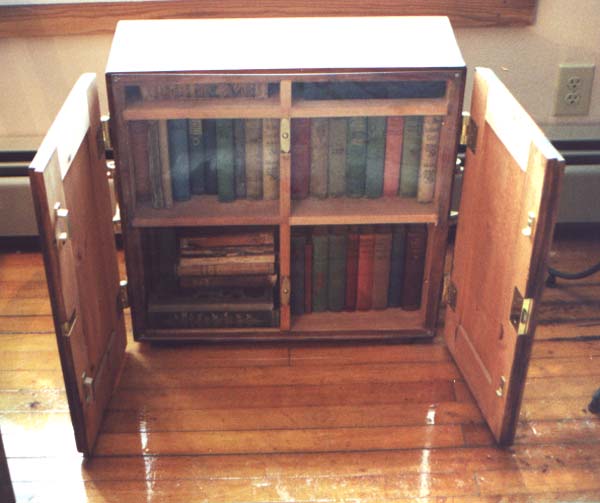
Lighthouses were often time located in remote areas and as such had no access to city services such as libraries, opera houses, entertainment, etc. that most people enjoyed who lived in a town or city. As light keeping was a lonely profession in most cases supplies were brought to them by lighthouse tender ships. One of the items the tender supplied was a library box on each visit as pictured to the left. Library boxes were filled with books and switched from station to station to supply different reading materials to the families.

Read more about the libraries here.

And for a great adventure story and taste of life in a lighthouse in the 19th century:

Friday, May 14, 2010

Celebrating Emily Dickinson


Emily Dickinson has been on my mind since I just installed a set of digital compositions combining hand-lettered lines by the poet with kaleidoscopic flower imagery at the Newton Free Library in Newton, MA.

This month's project is small book in celebration of Emily Dickinson. You can put one poem in the book, or a collection. I was inspired by Emily Dickinson's fascicles, small booklets into which she copied more than 800 of her poems. While Dickinson made the small volumes from folded sheets of paper that she bound with string, this book is a simple fold and cut book that I call the Hot Dog Booklet with papers from the collage box and lines from the poet.

Written directions


in Spanish

Video

A sheet of Emily Dickinson poems for your book


My Emily Dickinson Book on flickr

My Artwork: The Emily Dickinson Series

LINKS AND BOOKS
The Emily Dickinson Museum
A wonderful site with information about visiting the Homestead in Amherst, MA (a wonderful experience) and lots of information about Emily Dickinson and her poetry.


Jeannette Winter frames a short collection of Emily's poems with the story of her sister Lavinia finding the poems after Emily's death.


Jane Yolen tells a beautiful story of poetry, love, and truth-telling based on a poem and dead bee that Emily Dickinson gave to her six-year-old nephew, Gib.


Michael Bedard tells another story of Emily's connection with children is told here by a girl who lives across the street.


Elizabeth Spires wrote this delightful small chapter book about a mouse who lives in Emily's house and is inspired to write poetry. As the white mouse Emmaline describes herself: "Before I met Emily, the great poet of Amherst, I was nothing more than a crumb-gatherer, a cheese nibbler, a mouse-of-little-purpose.

Saturday, December 26, 2009

Twelve Days of Christmas


I make a big deal of the Christmas season and celebrate it throughout the twelve days (December 25-January 5). I am making a post for each day at in good spirit. Today's is about a book I made from felt figures my mother made back in the 1960s.

Here are my favorite books of The Twelve Days of Christmas:


Jan Brett


Gennady Spirin


Robert Sabuda


Ilse Plume

Monday, September 7, 2009

Book Dynamics by Ed Hutchins


Ed Hutchins creates editioned books that are both playful and profound. In Book Dynamics, he has produced a wonderful record of his bookmaking adventures since the late sixties. Through photographs and words, he tells the story of his journey as an artist and a person. He shares his enthusiasm, humor, and commitment to his art and to making the world a better place. Ed's own words are complemented by essays by William J. Dane, Newark Public Library Keeper of Prints and Works of Art, and artists Bertha Rogers and C.J. Grossman.

You can find out more about Book Dynamics at Ed's website.

Monday, July 27, 2009

Picture Books by E.B. Lewis


I just came across two wonderful books by artist and illustrator E.B. Lewis. In one, he created images that deepen our experience of the Langston Hughes poem, The Negro Speaks of Rivers. In This Little Light of Mine, a visual story that illustrates the meaning accompanies the African-American spiritual, "This little light of mine, I'm gonna let it shine." Lewis's masterful watercolors convey warmth, depth, and majesty. They speak to the soul and show us how powerful the combination of word and image can be.

You can find out more about his work at his website. Make sure your browser has a wide window open as the navigation is at the far right.

A report on E.B. Lewis's keynote at the New Jersey Society of Children's Book Writers and Illustrators Conference on Tara Lazar's blog.

Picture Books as Inspiration


Whenever you read or hear advice to writers, the one constant piece of advice seems to be: read. For the kind of simple bookmaking I do and advocate, my advice is to read and look at (we are usually working with the visual as well as the written) picture books. I just started taking my own advice and once a week or so visiting a small section of the picture books in the children's room at my local library. The books are filed by author's name. I've been picking a letter and browsing through. I choose whatever catches my eye and seems to fit my mood. I'm interested in what the story is, how it is divided among the pages, the style of the illustrations, and how they're integrated with the text.

Monday, May 11, 2009

Fantastic Five: Alphabet Books


Fantastic Five: Alphabet Books is the second in the Workshop Papers Series which are reasonably priced pdfs of my workshop handouts. They include directions for projects and photographs of completed works for inspiration. Fantastic Five has directions for five alphabet books that go beyond A is for Apple. This celebration of the power of the twenty-six letters and the words they make is recommended for grades 3 and up.

Available at lulu for $2.95.

Wednesday, April 29, 2009

Mole Music


The Newburyport Literary Festival closed with a program honoring children's book author and illustrator and native son David McPhail. Fontaine Dollas and the Joppa Jr. Jazz Dance Company performed a spirited original dance of David's book Pigs Aplenty, Pigs Galore with a reading by her husband Andre Dubus III. Jay Schadler gave a humorous and heartfelt tribute to his friend and introduced a film about David McPhail by Peter Vandermark. David then spoke about growing up in Newburyport and experiences at the Newburyport Public Library. The evening and the festival concluded with a reading of Mole Music by Maureen Daly, director of the Newburyport Montessori School, accompanied by Madeline and Claire Werner on violin.

The presentation of Mole Music left us all with inner glow from both the words of David McPhail and the poise and talent of the two young violinists. The book is proof that picture books are not just for kids and that simple stories can speak to us at a deep level. Mole lives underground and spends his days digging and his evenings watching TV. After seeing a violinist performing on TV, he orders one. His first sounds are horrible but he practices and practices until many years later he can play even better than the violinist he heard on TV. He is happier than he has ever been but wonders what it would be like to play for others. Although he doesn't know it, his music travels above ground and brings pleasure and peace to the world above. Mole Music speaks of the power of art to change the world and its intrinsic value whether it is made in a hole in the ground or in a concert hall or gallery.

Saturday, March 14, 2009

Welcome to the Aquarium


Welcome to the Aquarium by Julie Diamond takes us through one year in the life of a kindergarten teacher and her class at P.S. 87 in New York City. Excerpts from her journal thread through the book in which she describes her teaching methods and philosophy and her struggles to bring out the best in her class and herself as a teacher. There are many practical pieces of information but to me the most important overall point is that she is a teacher constantly engaged in self reflection through which she grows as a teacher and keeps engaged in the process. Julie Diamond is the kindergarten teacher we all wish we and our children had.

Our resources are our own capacities: Our Capacity to observe, especially at moments when nothing seems to be going on. Our capacity to be surprised by something a child said or did or made. Our capacity to be puzzled, and to mine puzzlement, to see something that escaped us earlier. Our capacity to recognize whatever has deep personal meaning, for our students and also for ourselves (a colleague's class study of birds). Not least, our capacity for friendship—our searching out sympathetic people, who provide the human environment we need. I began the school year, after all, walking to school with a friend. These are steps teachers can make immediately, right now; these resources—the capacities for observation, surprise, puzzlement, and connection—are always present. "Education in its widest sense," Carlina Rinaldi says, is "a hope for human beings."

In recognizing what matters to children and to ourselves, we develop a culture of teaching. The more years we teach, the more we understand what the work entails; and the more complex, colorful, and detailed the culture becomes. In choosing to teach, year after year, we
learn to teach; we gain conviction and we discover again and again who are as teachers.

Welcome to the Aquarium
is particularly valuable to those who work with young children but Julie Diamond's understanding of teaching has value for anyone involved in education. I found that three chapters, Collages: Making Art, Finding Curriculum: A Study of Squirrels, and The Uses of Literacy: Reading and Writing, were particularly applicable to bookmaking.

Wednesday, October 15, 2008

Sticker Poem Book


http://www.makingbooks.com/elastic.shtml

This book is a variation on the stick and elastic book. Because the plastic piece from the socks has a place for the elastic, I was able to wrap the elastic in the curves and run it along the inside of the folded pages.

As I made sample books for the Homes for Poems workshop at the Massachusetts Poetry Festival in Lowell, I had fun playing with recycled materials. This book used the side panels from a grocery bag for the pages, a plastic piece that came with a purchase of a pair of socks and an elastic for the binding, and candy wrappers, fruit stickers, and the left over sticky paper from red and green dot stickers that were left over from jurying at the Newburyport Art Association to decorate the pages. The poem was inspired by the fruits the stickers were on. You can view the entire book here.

As I was preparing for the workshop, I spent some time selecting a collection of poetry anthologies for children. You might not always want to write an original poem for your book; sometimes it's fun to use one of your favorite poems. Here is an annotated list in no particular order.

A Family of Poems: My Favorite Poetry for Children
Caroline Kennedy, paintings by Jom J Muth. New York: Hyperion Books for Children, 2005.
I like the collection of poems and Caroline Kennedy's reminiscences about reading and reciting poetry aloud with her family.

Around the World in Eighty Poems
Selected by James Berry, illustrated by Katherine Lucas, San Francisco: Chronicle Books, 2002.
Poems from more than fifty countries include traditional poems and songs and ones by contemporary poets. A nice introduction by James Berry closes with "Perhaps the poems in this anthology will build bridges for you. This collection offers you fresh poems as new acquaintances, which I hope will become new friends."

Talking Like the Rain: A Read-to-Me Book of Poems
Selected by X.J. Kennedy and Dorothy M. Kennedy, illustrated by Jane Dyer. Boston: Little, Brown and Company, 1992.
This delightful collection of poems for children is organized in the following sections: Play; Families; Just for Fun; Birds, Bugs, and Beasts; Rhymes and Songs; Magic and Wonder; Wind and Weather; Calendars and Clocks; Day and Night. The poems are great for reading aloud.

The Random House Book of Poetry for Children
selected by Jack Prelutsky, illustrated by Arnold Lobel. New York: Random House, 1983.
This was the poetry anthology we had in our library when my kids were young. There are lots of great poems organized in sections like The Four Seasons, Dogs and Cats and Bears and Bats, I'm Hungry!, and Alphabet Stew.

A Jar of Tiny Stars: Poems by Ncte Award-Winning Poets
edited by Bernice E. Cullinan, illustrated by Andi MacLeod. Honesdale, PA: Wordsong, Boyds Mill Press, 1996.
Poems by David McCord, Aileen Fisher. Karla Kuskin, Myra Livingston Cohen, Eve Merriam, John Ciardi, Lilian Moore, Arnold Adoff, Valerie Worth, and Barbara Esbensen are accompanied by a portrait of the poets, their writing about writing poetry, and a short biography.

This Place I Know: Poems of Comfort
selected by Georgia Heard, illustrated by eighteen renowned picture book artists including William Steig and Melissa Sweet. Cambridge, MA: Candlewick Press, 2002.
Georgia Heard was asked by a friend who is superintendent of District 2 schools in Manhattan to gather poems of comfort for New York schoolchildren who had witnesses the World Trade Center tragedy. These poems can bring comfort to all children, and adults, in whatever trying times they find in their own lives.

Hey, You!: Poems to Skyscrapers, Mosquitoes, and Other Fun Things
selected by Paul Janeczko, illustrated by Robery Rayevsky. New York: HarperCollins Publishers, 2007.
A selections of poems from humorous to serious written to things: sneakers, mosquitos, snowflake, buffalo, hat hair, the Vietnam Memorial. In the preface, the editor suggests writing your own poems to things and these are great inspirations to get started.

Talking to the Sun: An Illustrated Anthology of Poems for Young Peopleselected and introduced by Kenneth Koch and Kate Farrell. New York: Metropolitan Museum of Art, Holt, Rinehart and Winston, 1985.
A wide-ranging selection of poems ranging across time and place are illustrated with works from the Metropolitan Museum of Art. A feast of words and images.

Sing A Song Of Popcorn: Every Child's Book Of Poems
selected by Beatrice Schenk de Regniers, Eva Moore, Mary Michaels White, and Jan Carr, illustrated by Marcia Brown, Leo and Diane Dillon, Richard Egielski, Trina Schart Hyman, Arnold Lobel, Maurice Sendak, Marc Simont, and Margot Zemach. New York: Scholastic, Inc., 1988.
The well-chosen poems are grouped by theme and illustrator: themes and illstrators include Fun with Rhymes illusterated by Trina Schart Hyman, Mostly Weather illustrated by MArcia Brown, Mostly Animals by Arnold Lobel.

The Kingfisher Book of Family Poems (Kingfisher Book Of)
selected by Belinda Hollyer, illustrated by Holly Swain. New York: Kingfisher, 2003.
The family poems in this volume are broad in scope. They go from humorous to sad and include all kinds of families. A poem called I wish I was (an only child) is followed by I have none.

Heart to Heart : New Poems Inspired by Twentieth-Century American Art
edited by Jan Greenberg. New York: Harry N. Abrams, Inc. Publishers, 2001.
American poets were invited to choose a work of twentieth -century American art and write a poem inspired by it. The results were organized into four categories: Stories (poems about the art that tell an aanecdote or conjure a memory), Voices (poet steps inside the painting and assumes the voice of the person or object), Impressions (poets paint word pictures of the work of art), Expressions (poets explore aspects of visual form that concern the nature of art and the artist). The book is wonderful to look at and view and also can make a starting point for a collaboration between art and language arts teachers or for a visit to the museum.