

Showing posts with label Cultural Explorations. Show all posts
Showing posts with label Cultural Explorations. Show all posts
Wednesday, August 10, 2011
Wish Scroll at the Book Nook

Book Arts Tuesday/Bhutanese-Nepali Folktale Project
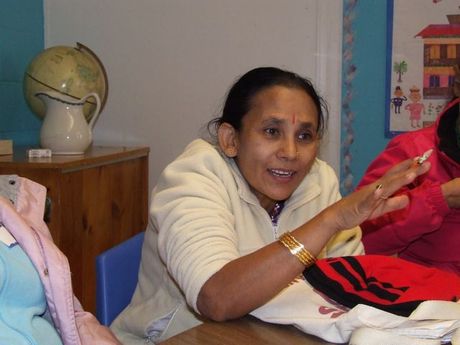
The project began by recording stories from the community. You can hear all of the stories here. The one that was chosen for the book project was The Pumpkin Husband told by Hari Tiwari (pictured above). The first meeting I attended in Laconia, NH was the one in which the story was chosen. Dal Rai, who is doing the illustrations, was there and left with the assignment to prepare a watercolor of a scene in the story. I took some iphone photos of some traditional fabric with the idea that it might be useful in the page design. In addition to decision making and lively conversation, we were treated to delicious soup and noodles prepared by Ambika Sharma.
My second visit was to an ESOL class where Hari told her story once again in Nepali and it was recorded by consulting folklorist Jo Radner. Dal brought us a watercolor painting and several drawings. I was fascinated to see the power of his drawings on the class. Many of the refugees have only memories of their homeland and his pictures gave them visual reminders of the life they left behind. A picture of an ox in a field with a basket muzzling its mouth sparked a lively discussion of farming and basket weaving.
At home, I scanned in Dal's painting and experimented with a design for the illustrated pages. The background is a scan of the Resho paper from Bhutan that I use in my Spirit Book workshops. The border around Dal's painting is from traditional fabric woven in Bhutan.

As the book will be bilingual, I did some experimenting with the page design for the text pages. I found some Nepali writing online as an image and used it for a test. The English is the standard dummy text used in printing. (You can find out some interesting facts about the origin of here.)

My third visit, last week, to Laconia was another visit to Ambika's where we scanned fabric including her beautiful wedding sari.
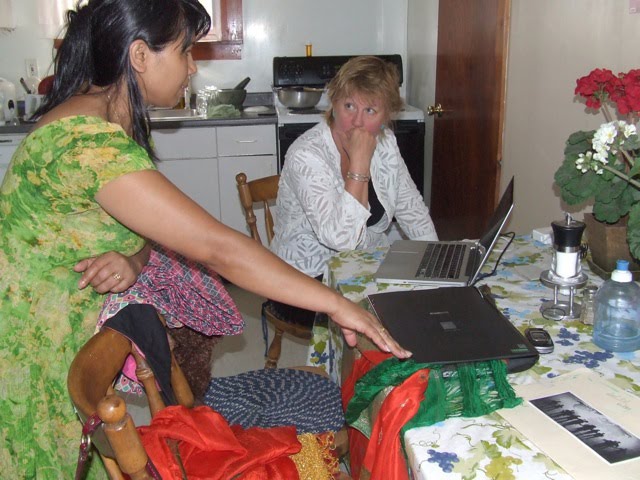

It is a privilege to be part of the project. I'll keep you posted on the progress.
Tuesday, August 2, 2011
Book Arts Tuesday/International Dunhuang Project

The Bookbinding section of the International Dunhuang Project is a wonderful resource. Here is a little bit of background about the project from the website:
Little was known of the remarkable heritage of the Silk Road until explorers and archaeologists of the early twentieth century uncovered the ruins of ancient cities in the desert sands, revealing astonishing sculptures, murals and manuscripts. One of the most notable discoveries was the Buddhist cave library near the oasis town of Dunhuang on the edge of the Gobi desert in western China. The cave had been sealed and hidden at the end of the first millennium AD and only re-discovered in 1900. Forty thousand manuscripts, paintings and printed documents on paper and silk were found in the cave itself. Tens of thousands more items were excavated from other Silk Road archaeological sites. These unique items have fascinating stories to tell of life on this great trade route from 100 BC to AD 1400. Yet most were dispersed to institutions worldwide in the early 1900s, making access difficult.
Rightfully they pride themselves on sharing the book structures of which there are many forms as well as the texts. There are photographs, diagrams, and thorough descriptions and explanations. This is from the section on Stitched binding (xian zhuang).
There are a number of booklets in the Dunhuang collection that have been bound with thread. The most striking aspect of these books is the fact that they appeared at such an early period. The colophons on some of the booklets tell us that they were copied and bound during the Tang dynasty (AD 618-907), some six hundred years before the emergence of mature thread binding books in the Ming. What is also surprising is that there was a whole variety of stitching techniques already being applied. It would be interesting, therefore, to have a look at some of these different techniques in order to understand the nature of this development in bookbinding.


The information is also available as a downloadable pdf. Thanks to Colin Chinnery for the text and Li Yi and Colin Chinnery for the diagrams.
International Dunhuang Project/Bookbinding
Tuesday, July 19, 2011
Book Arts Tuesday/Asian Books
Since the beginning of my interest in bookmaking, I have been drawn to the books of Asia. I love the range of materials from paper to palm leaves and the simplicity of the structures. I have a small collection grown from occasional shop purchases and the kindness of traveling friends who have sought out books for me. Although my teaching is very much about books as vehicles for content, I also have a deep love of books as objects. These images are a tribute to that love.


The top image was made from a book that Marie Oedel purchased in Bhutan.


The second from a palm leaf book I purchased in Great Barrington, MA at Barong Imports.


The top image was made from a book that Marie Oedel purchased in Bhutan.


The second from a palm leaf book I purchased in Great Barrington, MA at Barong Imports.

Friday, May 20, 2011
Invitation to World Literature

The thirteen books include The Epic of Gilgamesh, The Popol Vuh, The Bhagavad Gita, The Odyssey, The Thousand and One Nights, and the more contemporary Things Fall Apart and One Hundred Years of Solitude.
For each book, there are three categories:
WATCH (a video introducing each book with historical context and thoughts from scholars, writers, artists, and teachers)
READ (Getting Started, Read the Text, Expert's Views, Translations and Editions, and a Glossary with pronunciations to listen to)
EXPLORE (Timeline & Map, Slideshow, Connections, Key Points)
There are hours and hours of learning and adventure to be found at the Invitation to World Literature.
Wednesday, May 4, 2011
Bookmaking in Cuba

I also wanted to send you photos of some of the children’s nature/flower books that were completed about three weeks ago in Havana in one of the workshops I conducted there. It was a big class of 18,mixed ages, probably from about 5yrs to 16yrs!!! With this class I tried to include as many as I could in the neighbourhood. The covers were made from donated centre cuts from art matboards from a framer which I brought with me to Cuba, the paper for the accordion was a nice heavier weight paper. I know you are a huge promoter of recycled materials but in the case of Cuba, I like to bring them beautiful papers that they may have never seen before...it is a real treat for them. The images were made from their choices of beautiful collage papers, stamps and ink pads, and various sizes of coloured markers, or as you will see, all three!! They loved the workshop and there was paper, glue sticks, and ink pads flying...it looked like a cyclone had swept through....
I have sent one photo of the workshop in action and then individual shots of open books. Hope you enjoy them. I have told the children that I was sending you some photos and they were thrilled to think that someone else they didn’t even know,wanted to see them.


Saturday, April 9, 2011
National Poetry Month/Sijo

Here's a link to a previous post with information on writing sijo, a simple book project, and more information about Linda Sue Park's book.

Monday, March 14, 2011
St. Patrick's Day Cross

For St. Patrick's Day, I wanted a project that wasn't about shamrocks or leprechauns and had traditional roots in Ireland. I found this in The Year in Ireland: A Calendar by Kevin Dannaher. The book is out of print but can be found on half.com and other sources.
Young girls and small children wear on the right shoulder "a St Patrick's Cross", consisting of a single or double cross formed of pieces of narrow silk ribbon stitched to a circular disk of white paper, nicked at the edge, and measuring from 3 to 4 1/2 inches in diameter. At the ends of the arms of the cross a very small bow or rosette is stitched and one a trifle larger at the junction of the arms; the more and the brighter the colours of the silk, the more handsome is considered the St Patrick's Cross.
Journal of the Kildare Archaeological Society 1908
I made my cross from a piece of white shirt cardboard. I used pieces of plastic bag instead of silk ribbon. Even though I make an effort to carry a bag with me shopping, plastic bags do seem to multiply. I went through my bag of bags before I took them back to the supermarket and selected ones with color to make the ribbons and bows. I cut narrow strips and tied them into bows. The plastic bag I used for the center wasn't long enough to tie a bow so I just shaped one. I stitched the plastic ribbons and bows onto the circle but you could also use a stapler.
Monday, March 7, 2011
A Photographer in Old Peking

Hedda Morrison was raised in Germany and in 1933, at age 25, went to Beijing to manage Hartungs Photo Studio. She lived and worked in China until 1946 and recorded the time and place through her black and white photographs. She photographed temples and palaces, street life, art and crafts, and food and entertainment in Beijing and also ventured further afield in China. In the book-related department, there are pictures of papermaking, bookmaking and selling, seal carving. The photographs are introduced by her straightforward text which gives a sense of the world she saw around her and reading between the lines, the open and intrepid spirit that she brought to her life in this foreign city.


Two places to learn about Hedda Morrison and her work are the websites of:
The Powerhouse Museum in Sydney, Australia
Harvard-Yenching Library in Cambridge, MA
Saturday, March 13, 2010
Celtic Knotwork

In celebration of St. Patrick's Day and in anticipation of the Oscar nominated animated film The Secret of Kells which I can't wait to see, this month's project is Celtic knotwork.
I made a hot dog booklet from the back panel of a brown grocery bag and followed directions on the web for making Celtic knot designs. There are directions using graph paper but I preferred the simpler way of drawing the design in crayon, marker, or colored pencil and then adding the outlines to make the interlocking knots.
Written directions
in Spanish
Video
My Book of Celtic Knotwork on flickr
LINKS
Book of Kells at the Trinity Library in Dublin
Book of Kells DVD
This short video promoting the DVD gives some close-up views of pages from the Book of Kells. You can purchase a copy at John Neal Booksellers.
The Secret of Kells website
You can watch the film's trailer here.
Celtic Knots
This was my favorite site for Celtic knots. It was here I found the draw first, outline later method which is called felt-tip pen on the website. There are also outlines which you can print and color or trace over and then add outlines as well as lots more information.
Celtic Knotwork
I liked this site a lot too. There is a method of drawing your own simple grid and then building the knotwork design.
Art by Deirdre McCullough Greenwald
My friend Deirdre has been using Celtic knotwork in amazing ways in her work for many years. You can see samples of her work here.
Monday, January 18, 2010
Prayer Flags

Sometimes I stretch the interpretation of what a book is and the prayer flags are an example. They can be viewed as separate pages joined together—a book. The flags (pages) were cut from different colored recycled plastic bags. The writing was done with waterproof marker. I made them last winter at about this time and they were in perfect condition when spring came. They were a welcome sight as we walked out our back door on cold and icy winter days. The pages are hung on string made from connected loops of plastic bags. Some people call it plarn (plastic yarn) but I kind of like the word I came up with, pling (plastic string). I wrapped the top of the flag page around the pling and stapled it around rather than to it so that the flags could move freely. You can find directions for making plarn/pling here.
LINKS
Tibetan Prayer Flags
This site selling Tibetan prayer flags has thorough and well illustrated information about the history and traditions as well as symbols, colors, and meanings of traditional prayer flags.
The Dream Flag Project
connects students to their dreams and their dreams to the world through writing poetry, through creating art, and through the words of Langston Hughes.
Subscribe to:
Posts (Atom)


