Friday, October 8, 2010

Lighthouse Libraries


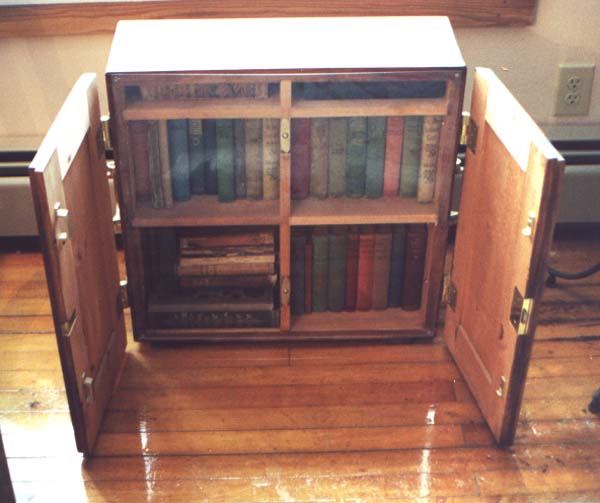
Lighthouses were often time located in remote areas and as such had no access to city services such as libraries, opera houses, entertainment, etc. that most people enjoyed who lived in a town or city. As light keeping was a lonely profession in most cases supplies were brought to them by lighthouse tender ships. One of the items the tender supplied was a library box on each visit as pictured to the left. Library boxes were filled with books and switched from station to station to supply different reading materials to the families.

Read more about the libraries here.

And for a great adventure story and taste of life in a lighthouse in the 19th century:

Saturday, September 11, 2010

Bee Accordion


And still more, later flowers for the bees,
Until they think warm days will never cease,


I always read John Keats's poem To Autumn at this time of year. My favorite lines are the first two, "Season of mists and mellow fruitfulness, Close bosom-friend of the maturing sun", but bees are on my mind this year. Our summer trip to Utah brought us images of old fashioned beehives as they are the symbol of Utah and appear on every state highway sign. My mother-in-law gave us a a jar of delicious honey from her hive along with tales of its retrieval. And I love watching the collection of bees and pollinators of all sorts on our flowers.

I made a four-page accordion from the back panel of a grocery bag cut in half the long way. I then cut the folded pages into the shape of a hive, leaving the two sides untouched until about 2/3 of the way up the side of the book. (You can make all kinds of shapes but always have to remember to keep some of the sides intact. Otherwise, you'll have four separate pieces instead of an accordion.) I used a cereal box panel for the covers and made them just a tiny bit larger than the pages. I then covered the covers with pieces of grocery bag.

Written directions

in Spanish

Video

A closer look at My Book About Honeybees


LINKS

Tales from the Hive
NOVA page on the honeybee.

Honey Bees Life Cycle Video
Excellent youtube video with lots of close-up views. And on TeacherTube.

Life Cycle of Bee PDF
Life cycle of bees illustrated with photographs.

Busy Bees
A website by students at Heard Elementary Academy.

Beekeeping and Children
Information on beekeeping from the Liberty 4-H in Petaluma, CA.

Friday, September 10, 2010

Wish Scrolls at Wenham Museum


I spent a Saturday morning at Family Day at the Wenham Museum making wish scrolls, one of the projects in Handmade Books For a Healthy Planet. When I first made wish scrolls, based on traditional scrolls in containers from Ethiopia, I used film containers. They are becoming harder to find so I used prescription containers instead. We used brown paper grocery bags for the scrolls and to decorate the outside. I love how there is always a new adaptation and something new to learn. I had buttons and beads to add and someone came up with a way of stringing and attaching them that I hadn't thought of. We all learn from each other. I especially liked that the scrolls were made by some adults alone as well as by children. Bookmaking is for everyone.

Tuesday, September 7, 2010

Spirit Book Workshop at Barnard School


It's unusual to have the opportunity to give a non-curriculum specific workshop to teachers but the Barnard School in South Hampton, NH invited me to do an afternoon Spirit Book workshop as a way to give teachers a calm place to center themselves before the start of the school year. We used the front and back panels of grocery bags for the books and gathered natural materials outside. I think process is more important than product but you can see how wonderful the books they created turned out here.

Friday, September 3, 2010

Handmade Books for Literacy


This is a fabulous project. Members of the North Redwoods Book Arts Guild in California made 1,000 small handmade books which are being sold for $1.00 each to benefit a local literacy program. They used what I call the hot dog booklet.

About the project:
Article in the Times-Standard

Book Arts Guild blog

How to make your own hot dog booklet:

Monday, August 16, 2010

Name Book


We made this simple name book as the introductory activity in the teacher workshop in Utah this summer. Each person had one sheet of copy paper with writing on one side, two covers cut from cereal boxes (for US Letter paper the covers were 3" x 4.5"), glue stick, scrap paper, and scissors. On each table was a pile of miscellaneous collage papers. A good way to place them is in styrofoam trays for vegetables from the supermarket. I led the class through the construction of the accordion book. Each person then cut the letters of her (or his) name out of the collage papers and glued them across the accordion.

I like starting with this activity because it gives a taste of both aspects of bookmaking in one small package: following directions in the construction phase and independent creative work in the name phase. It also uses the accordion book as one long panel rather than separate pages and sends the message that book s can be places to experiment and have fun.

We did a show and tell of our books and used them to introduce ourselves. We then hung them from a yarn line for some instant room decoration. You could also have branches in a container and hang the books.

If you are doing it with a class, I think it's important for you to make a book along with the children. I think we need to take every opportunity we can to show our students that we are all in this together. We often forget that we are asking them to put themselves on the line every time they write something and share it and we need to acknowledge it and sometimes do the same.

Written directions

in Spanish


Video

Links and a Book

Meaning of Names
I thought this was the easiest to navigate (and no pictures of pregnant bellies as on the baby name sites). Susan means lily in Hebrew.

Popular Baby Names
Look up the most popular names by year as registered with the Social Security Administration. Susan was number 6 in the year I was born.

Name Days
In many cultures, name days are celebrated in addition to or in place of birthdays. My name day is August 11. Here's the wikipedia entry.

Happy Name Day
Find your name day here.

The Name Game: A Look Behind the Labels
by Donna M. Jackson
Interesting collection of information about names including babies, pets, hurricanes, companies, and more. Comic illustrations by Ted Stearns.

Wednesday, August 4, 2010

Yes to Summer Reading

The NY Times had an excellent article on the value of summer reading based on a three-year study of low-income children in Florida. Of particular importance was that the children were allowed to choose their own books.

From the article:

Ellen Galinsky, president of the Families and Work Institute and author of a new book about how children learn, “Mind in the Making,” said she hoped that the findings would encourage parents and teachers to allow children to select their own reading material.

“A child’s interests are a door into the room of reading,” said Ms. Galinsky, who said her own son turned away from books during grade school. Because he liked music, she encouraged him to read music magazines or books about musicians. Her son later regained an interest in reading and has a Ph.D.


One of the reasons I have become so involved family bookmaking is related to choice. Kids need to be able to write about what interests them and there is little time for that in most schools. By making books at home, they will have a place to pursue their own passions. Books about music and musicians for example.

And this article about summer reading reminded me of a letter I wrote to the editor of our local paper about summer reading. My complaint was that kids were assigned projects to do about their reading which totally missed the point of summer reading: pleasure. Note that my reference point for competition to reading is television. How far the screen has extended into our lives since then.

When the Summer Reading program was first introduced, I thought it was a good idea. It would keep kids reading and give them a chance to do it without the pressure of additional schoolwork and book reports. The summers flew by, the reading was often done at the end of the summer in anything but relaxed circumstances, but I still supported it. The last two years the program has expanded to include written responses to the books and a small project.This year the reading was enjoyable and finished on time. The selection of books has been a good one. But now we are faced with the written projects and I say let’s go back to just reading.

I had been questioning whether I was being a lazy parent. Am I going to send my child out unprepared to compete with the Japanese and Singaporean children because I don’t feel like nagging over the summer?

Our family vacation changed my mind. We all brought books with us. I read three novels, my husband one, and my seventh grader, one. For the adults, it was pure joy. The seventh grader couldn’t put his book down, but it was not pure joy. There was always this feeling that he should be writing a response, answering one of the questions provided. I thought how different my feelings would be if I knew I had to write written responses for the three books I read.

I think the Summer Reading Program should be the time to inspire students with the love of reading and if not love, at least a sense that reading can be a pleasurable experience. It is the time to help create lifelong reading patterns. One can argue that the kids can read additional books for pleasure, but the sad fact is, most won’t. Reading is in competition with television and television has the advantage. It’s easy; the images are provided. We just sit and absorb. Reading is work. We have to decode and comprehend the words and then create the images in our heads. When we’re comfortable with it, it gives us freedom. Until we are, it can be a struggle.

We cannot forget that this competition between books and television exists. By requiring written work only from reading, we give television an unfair advantage. Summer is the time to build the habit of reading for fun, the time to learn to see reading as a richer form of entertainment than television. Therefore, I urge the Newburyport Public Schools to eliminate the writing component from the Summer Reading Program. Evaluations
of the students comprehension can be done in class at the start of the year. Let our children have the same pleasure we do for their summer reading.